
I had a conversation with one of our better head chefs that was very enlightening and I've never really forgotten. We were sitting down to do a new menu, and I asked him to walk me through the food cost on our existing top ten sellers. He knew the rough number on four of them. For the others, he gave me some pretty wild guesses. These were items that were selling every single service in big numbers, and he genuinely wasn't sure.
That wasn't a criticism of the chef. He was talented, he cared, and he was good at his job. It was a systems problem. Food cost calculation for every dish is time-consuming when done manually, it goes stale fast when supplier prices change, and without the right tools it gets deprioritised every time the kitchen gets busy. Which is basically, always.
But here's what that conversation drove home for me: you cannot make confident decisions about your menu without knowing the food cost percentage on each dish. You can't do menu engineering. You can't make a confident pricing call. You can't know whether your bestseller is a Star or a Plowhorse. You're guessing — and in a business where 2–3% of food cost is the difference between a good year and a bad one, guessing gets expensive.
This guide walks through the formula step by step, with a worked example, the benchmarks to aim for in Australia and New Zealand, and where this calculation fits into the bigger menu engineering picture.
What is food cost percentage per menu item?
Food cost percentage per menu item is the ingredient cost to make one serving of a dish, expressed as a percentage of the selling price. It shows you, for each individual dish, what proportion of the revenue goes directly to ingredients.
It's different from your overall food cost percentage, which measures total COGS as a proportion of food sales across the venue. Per-dish food cost works at the recipe level. It's the number that tells you whether a specific dish is performing well or quietly eroding your margin.
Most operators roughly know their venue-wide food cost. Far fewer accurately know the food cost on each individual dish. The gap between those two things is where margin disappears.
How do you calculate food cost percentage for a menu item?
To calculate food cost percentage for a menu item, list every ingredient used in one serving, multiply each ingredient's quantity by its current cost per unit, add them together to get the total ingredient cost, then divide by the selling price and multiply by 100.
The formula:
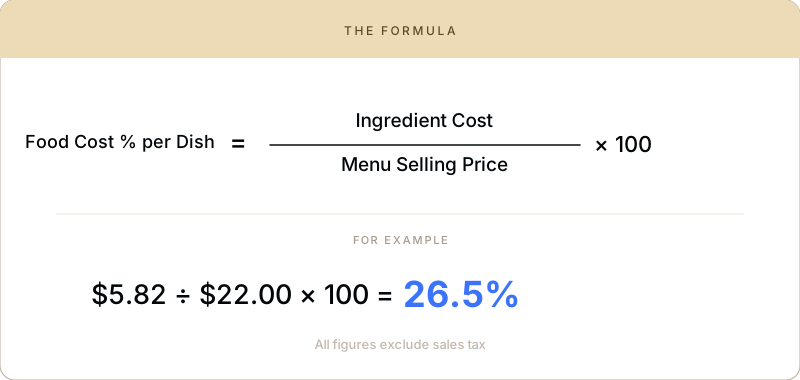
Food Cost % per Dish = (Total Ingredient Cost ÷ Selling Price) × 100 (All excluding GST)
Step-by-step example: chicken caesar salad, selling price $22
- 150g chicken breast: $3.45 (at $23/kg)
- 60g cos lettuce: $0.42
- 20g parmesan: $0.56
- 30ml caesar dressing: $0.28
- 2 rashers bacon: $0.76
- 1 slice sourdough: $0.35
- Total ingredient cost: $5.82
Food cost % = ($5.82 ÷ $22.00) × 100 = 26.5%
That sits inside the healthy range for a pub or casual restaurant. But if chicken prices rise from $23/kg to $28/kg, the chicken component alone moves from $3.45 to $4.20. The dish now costs $6.57 in ingredients, pushing food cost to 29.9%. Nothing else changed. The margin moved because a supplier price changed.
This is exactly why per-dish food cost needs to be a live number, not a one-time calculation.
What food cost percentage should each dish be targeting?
The right food cost percentage for an individual dish depends on your venue type and your overall food cost target — there is no single number that applies across the board.
The benchmarks we see across well-run venues in Australia and New Zealand, by venue type:
Venue typeOverall food cost targetNotesFine dining18–24%High menu pricing and smaller portions offsets individual dish costsPubs and casual restaurants25–30%Most common category for multi-venue operatorsCafes and quick-service28–35%Higher food cost offset by lower labour %; less pricing leverage
Fine dining: 18–24% overall food cost. In fine dining, higher menu pricing and smaller portions means the overall food cost runs low. Individual dishes can sit higher — a prime beef dish might land at 30% — but it's balanced by high-margin items.
Pubs and casual restaurants: 25–30% overall food cost. This is the most common category for multi-venue operators. A pub doing $80,000 a week across kitchen and bar should be targeting this range combined. Individual dishes will sit above and below the target — your steak will pull high, your pasta will pull low — and your job is to understand the mix well enough to manage the weighted average.
Cafes and QSR: 28–35% overall food cost. Cafes and QSRs run a higher food cost percentage than most expect, because lower average spend per customer means less pricing leverage. The offset is typically lower labour as a percentage.
For the full breakdown — including why Australian and New Zealand operators should never benchmark against US food cost figures — see What's a Good Food Cost Percentage for a Restaurant in Australia?
The implication for per-dish costing: every dish on your menu needs to be understood in the context of your overall target. If you're running a casual restaurant targeting 28% combined food cost, your steak at 38% needs a chicken dish at 22% and a pasta at 20% to balance it out. That balance only becomes manageable when you know the food cost percentage on every dish — and when those numbers update automatically as supplier prices change.
What mistakes do operators make when calculating food cost per dish?
Using prices that are months out of date. A chef who costs a dish in January and doesn't update it when chicken prices move in March is working with wrong numbers. The recipe looks fine on paper. The margin is shifting without anyone knowing.
Ignoring the Q Factor. The Q Factor accounts for everything that goes into a dish but doesn't appear in the formal recipe: cooking oil, salt, pepper, garnishes, condiments, the bread and butter that comes with a steak, the lemon wedge on the side. In a sit-down restaurant, the Q Factor typically adds 5% to the raw plate cost. Skip it and your calculated food cost will be consistently lower than your actual food cost.
Treating it as a one-time job. A well-costed menu from six months ago is not a well-costed menu today. Supplier prices move. Portions drift as team members change. A chef plating 20g heavier than the recipe specifies is eroding margin every service.
Using a spreadsheet that isn't connected to your purchasing data. When ingredient costs update in your invoicing system but not in your recipe spreadsheet, the number you're looking at is wrong without you knowing it.
How does per-dish food cost connect to menu engineering?
This is where the calculation becomes genuinely powerful for a multi-venue group.
Once you know the food cost percentage on every dish, you can plot your full menu on the engineering matrix, mapping each item against two variables: margin (food cost %) and popularity (covers sold). That gives you four categories:
Stars: high popularity, strong margin. The dishes you protect, promote, and make sure your team knows how to sell. Your most valuable menu items.
Plowhorses: popular but lower margin — often the protein-heavy dishes with loyal regulars. Your job with a Plowhorse is to understand whether you can improve the margin through supplier negotiation, portion adjustment, or a small price move, or whether the dish earns its place through volume contribution.
Puzzles: strong margin but low volume. The food cost looks great but nobody's ordering. That's a description problem, a placement issue, or a dish that doesn't match your customer base. Worth investigating before removing.
Dogs: low margin and low volume. These usually need to come off.
None of these decisions are possible without reliable per-dish food cost data. The matrix is a framework. The calculation is the evidence it runs on.
For the full framework, see Menu Engineering for Restaurants — the pillar page for this cluster — and The Menu Engineering Matrix Explained for a detailed breakdown of all four categories.
How does technology make per-dish food cost practical to maintain?
The manual version of this — pulling recipe cards, checking recent invoices, updating portion costs in a spreadsheet — takes 20–30 minutes per dish when done properly. For a menu of 20 items, that's 6–8 hours of work. And it starts going stale almost immediately.
Loaded's recipe costing links your recipes directly to your supplier invoice data. When an invoice arrives from your chicken supplier and the price has changed, every recipe that uses that ingredient updates automatically. The food cost on the caesar salad example above reflects what you actually paid this week, not what you paid six months ago.
For a multi-venue group, this matters more. When every site is receiving stock through the same system, you can compare per-dish food cost across venues. Is the burger costing $1.20 more to produce at Venue 3 than Venue 1? Is that a supplier difference, a portion control issue, or over-portioning happening on the floor? These aren't questions you can answer without consistent, current costing across all sites.
When chefs can see the real-time margin on their best sellers, the conversation in the kitchen changes. They stop thinking purely about volume and start thinking about which dishes are actually making money. That's the shift that moves the numbers.
Frequently Asked Questions About Food Cost Percentage Per Dish
What is food cost percentage per menu item?
Food cost percentage per menu item is the total ingredient cost to make one serving expressed as a percentage of the selling price. It shows what proportion of each dish's revenue goes directly to ingredients. It's different from your venue-wide food cost percentage, which measures total food COGS as a proportion of all food sales. Per-dish food cost works at the recipe level and tells you whether a specific dish is performing well or quietly eroding your margin.
How do you calculate food cost percentage for a menu item?
Add up the cost of every ingredient in one serving (quantity per serve multiplied by current cost per unit). Add 5% for the Q Factor (oil, salt, garnishes, condiments). Divide the total by the selling price and multiply by 100. Example: total ingredient cost $5.82 on a dish selling for $22.00 gives a food cost of 26.5%. The number is only accurate if the ingredient prices reflect what you actually paid this week.
What is a good food cost percentage per dish in Australia?
There is no single target — it depends on your venue type. Fine dining typically targets 18–24% overall food cost. Pubs and casual restaurants aim for 25–30%. Cafes and QSR run 28–35%. Individual dishes will sit above and below your venue's overall target, and your job is to manage the weighted average across the full menu. Australian and New Zealand operators should not use US benchmarks — the different labour model (no tipping) means the numbers don't translate. See What's a Good Food Cost Percentage for a Restaurant in Australia? for the full breakdown.
What is the Q Factor in food costing?
The Q Factor covers the items that go into a dish but don't appear on the formal recipe card: cooking oil, salt, pepper, herbs, garnishes, condiments, and anything else that comes with the dish by convention. In a sit-down restaurant, the Q Factor typically adds 5% to the raw plate cost. Ignoring it means your calculated food cost will consistently run lower than your actual food cost, and your margin will look better on paper than it is in practice.
How does per-dish food cost connect to menu engineering?
Menu engineering classifies every dish as a Star (high margin, high popularity), Plowhorse (popular but lower margin), Puzzle (good margin, low volume), or Dog (low margin, low volume). Without accurate per-dish food cost data, you can't reliably place any dish on that matrix. The matrix is the framework; per-dish food cost is the evidence it runs on. A food cost figure that's six months out of date will misclassify dishes and produce the wrong decisions about which items to protect, promote, reprice, or remove.
How often should you recalculate food cost per dish?
In practice, per-dish food cost should update every time a supplier price changes. Recipe costing software linked to supplier invoices does this automatically — when a new invoice arrives, every recipe that uses that ingredient recalculates. Operators running spreadsheets should update at minimum quarterly and after any significant supplier price movement. The riskiest approach is calculating once and assuming it holds — food costs can shift materially within a single quarter.
Next steps
If you're not currently calculating food cost at the dish level, start with your five highest-selling items. That alone will tell you more about your menu than most operators know.
If you're doing it manually and your costs are going stale, see how Loaded's recipe costing keeps dish costs current automatically.
And if you want to use per-dish food costs to classify your full menu on the engineering matrix, start with Menu Engineering for Restaurants.
Or book a 30-minute demo to see how it works across your own venues.
See how Loaded can work for your business
If you’ve never seen Loaded in action, jump over and book a demo with us. 30 minutes is all we’ll need to show you the magic!


More Profit
Making money doesn’t happen by accident! Learn how to tune your business and improve your bottom-line.



More Success Stories
Get inspired by stories from real Loaded customers who run thriving hospitality businesses.




More Labour
Get tips for optimising your staff’s time, and for managing your team effectively.


.jpg)
More Culture
Making money doesn’t happen by accident! Learn how to tune your business and improve your bottom-line.



More Design
Making money doesn’t happen by accident! Learn how to tune your business and improve your bottom-line.


More Design
Making money doesn’t happen by accident! Learn how to tune your business and improve your bottom-line.

More Design
Making money doesn’t happen by accident! Learn how to tune your business and improve your bottom-line.



Season 2: Spring Bootcamp for a Money-Making Summer
We've poured our 100+ combined years of hospitality experience into a series of live and recorded webinars that will be your bootcamp for a money-making summer.