
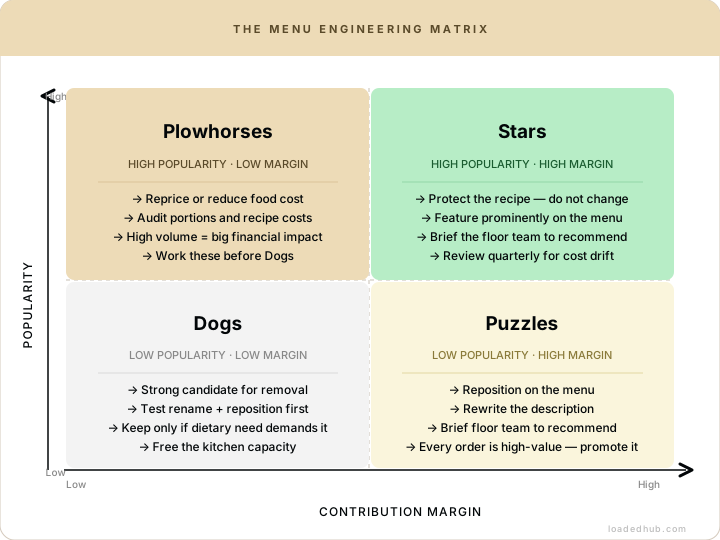
The menu engineering matrix is a framework that classifies every item on your menu by two measures: how often it sells (ie how popular it is) and how much gross profit it generates every time you sell it (gross margin). Items above your menu average on both measures are Stars. Above average popularity but below average margin: Plowhorses. Below average popularity but above average margin: Puzzles. Below average on both: Dogs. The four categories each carry a clear action -protect Stars, fix Plowhorses, promote Puzzles, remove Dogs.
There is one dish in most restaurants that everyone loves. The floor team loves selling it. The kitchen loves making it. On a busy Friday night it goes out on almost every table. But when you sit down with the numbers, you find it is contributing $5 and 8% less per serve than a dish that barely sells.
That is a Plowhorse. And finding it is exactly what the menu engineering matrix is for.
The matrix does not change your menu overnight. But it shows you, in clear terms, which dishes are working for your business and which ones your business is working for. That gap, between the popular and the profitable, is where a lot of operators are losing money, every service.
This guide covers the mechanics of the matrix in full: how each quadrant is defined, how to classify your items, what the strategy is for each category, and why the whole framework depends on having accurate recipe costs to underpin it.
What is the menu engineering matrix?
The menu engineering matrix plots every menu item on a two-axis grid. Popularity on the vertical axis, contribution margin on the horizontal axis and assigns each item to one of four quadrants: Stars, Plowhorses, Puzzles, or Dogs.
Contribution margin is the gross profit a dish generates per serve: menu price (excluding GST) minus food cost per serve. Popularity is measured as each item's share of total covers over the analysis period. The midpoint on each axis is your menu average, not an industry benchmark. This makes the matrix relative to your menu, your venue, and your customer mix.
The framework was developed by Michael Kasavana and Donald Smith at Michigan State University in the 1980s and has remained the standard tool for menu profitability ever since. Its durability comes from its simplicity: two inputs, four categories, four actions.
For a broader overview of menu engineering, including how to run a full analysis step by step, read the complete menu engineering guide for Australian restaurants.
How do you classify a menu item using the matrix?
To classify a menu item, you need two numbers: its contribution margin and its share of total covers over a fixed period (four to eight weeks gives a reliable picture of normal trading).
- Calculate the gross margin for every item: menu selling price (excluding GST) minus food cost per serve.
- Calculate each item's popularity: units sold divided by total covers, expressed as a percentage.
- Find your menu averages: average gross margin across all items, average popularity across all items.
- Classify each item against those averages. Above both: Star. Above popularity, below margin: Plowhorse. Below popularity, above margin: Puzzle. Below both: Dog.
One important note on how to compare items: compare like with like. Entrees against entrees. Mains against mains. Desserts against desserts. Running starters against mains produces a distorted picture because price points and natural popularity differ by course. Calculate a separate average for each section and classify within it.
The matrix starts with contribution margin, which starts with accurate food cost per dish. For a step-by-step formula and worked example, read the guide to food cost percentage for each dish.
What makes a menu item a Star, and how do you protect it?
A Star sells above your menu's average popularity and generates above-average contribution margin. It is your most valuable classification. Stars are what a profitable menu is built around.
The strategic priority with Stars is not to improve them, it is to not break them. The biggest risks are eroding the recipe to save cost, raising the price beyond what the market will absorb, or letting quality drift under kitchen pressure. Stars typically look after themselves. The discipline required is in not changing what is working.
What to do with Stars:
Feature them prominently on the menu. Prime page position, strong descriptive copy, staff recommendation in the first interaction with a table. Your Stars should be the easiest dishes on the menu to sell because they make money every time they go out.
Maintain recipe discipline. The contribution margin that made a dish a Star can erode quietly if portion sizes drift or supplier substitutions change the cost. A weekly kitchen check on your top Stars takes ten minutes and protects significant margin.
Review quarterly. A Star today can become a Plowhorse if ingredient costs move without a corresponding price adjustment. The dish did not get worse. The numbers shifted. A quarterly review keeps your matrix current.
A worked example: lamb rump priced at $36 (excluding GST), food cost $9 per serve (25%), contribution margin $27. It accounts for 9% of covers on a menu where the average is 5%. The action is straightforward: protect the recipe, hold the price, feature it on the menu and in the floor team's pre-service briefing. No changes unless the food cost moves significantly. If your chicken supplier puts up prices 8% next month, the lamb rump is unaffected. If your lamb supplier does the same, check whether the margin still sits above your menu average before doing anything else.
What makes a menu item a Plowhorse, and how do you improve it?
A Plowhorse sells above your menu's average popularity but generates below-average contribution margin. It is your busiest dish and your weakest financial performer.
Plowhorses are the most financially significant quadrant to work on. Not Dogs. A Dog sells rarely, so removing one has a limited financial impact. A Plowhorse sells constantly, so even a $2 improvement in contribution margin compounds across a high number of covers. Every week you leave a Plowhorse unaddressed, it costs you more than the week before.
What causes a Plowhorse?
The most common cause is time. A dish was priced when ingredients cost less. Input costs went up gradually, across multiple supplier price changes — and the sell price never followed. The dish still sells well because it has always been on the menu, customers know it, and the floor team loves an easy sell. Nobody noticed the margin compressing because no one was watching the contribution margin against current costs.
The second cause is portion drift. The recipe says 180g of protein. After two years, the kitchen is plating 210g because that is what feels right at service. No one adjusted the food cost. The dish still looks like it is hitting the target.
What to do with Plowhorses:
First, verify the recipe cost at current purchase prices. Before making any pricing or recipe decision, confirm exactly what the food cost per serve actually is today — not what it was when you last ran the numbers. The gap between the recorded cost and the current cost tells you how much of the Plowhorse problem is a pricing issue and how much is a purchasing or portioning issue.
Then consider a price increase. A popular Plowhorse has already demonstrated that customers value it. A $2–$3 price move is frequently absorbed without meaningful resistance, particularly if the dish has been on the menu at the same price for more than 12 months.
Review the portion. If the food cost is above target, run a portion audit alongside the price review. A 20g reduction on a protein-heavy main that sells 80 times a week is a material saving, particularly if the $2 price increase is applied simultaneously.
Let's break down a real-life example: fish and chips priced at $28 (excluding GST), with a food cost of $10.50 (37.5%), and a contribution margin of $17.50. It's the top seller, making up 15% of covers. The average contribution margin across the menu is $22, leaving a $4.50 gap per serve. By bumping the price to $30.50, the food cost percentage drops to 34.4%, and the contribution margin jumps to $20. A quick portion check reveals the batter and fry costs are higher than expected. With these tweaks, the contribution margin hits $21.20, finally surpassing the menu average after two years. With 80 covers a week, this $3.70 boost adds up to $296 extra weekly, $1,184 monthly, and over $15,000 annually from just one dish.
The conversation with the kitchen is sometimes the hardest part. "Why are we raising the price of the most popular dish?" is a reasonable question. The answer is the data: the dish is popular, in part, because it has been underpriced relative to what it costs. Show the margin gap, not just the opinion.
What makes a menu item a Puzzle, and how do you increase its sales?
A Puzzle generates above-average contribution margin but sells below your menu's average popularity. Every time someone orders it, the dish contributes well to the business. The problem is volume.
Puzzles are opportunities, not failures. The food cost is right. The margin is there. The issue is that not enough people are choosing it, and most of the time that is a presentation or awareness problem, not a food problem.
Common reasons a dish is a Puzzle:
Poor menu placement. It is buried at the bottom of a section or on a page the eye does not naturally reach. Menu position drives ordering behaviour more than most operators realise.
A weak menu description. "Duck breast with seasonal accompaniments" gives a guest nothing to hold onto. "Twice-rested duck breast, roasted cherry and red wine jus" is specific, sensory, and more likely to be ordered. The dish did not change. The words did.
Low floor team awareness. If your team does not actively recommend a Puzzle when a guest asks for guidance, it will stay where it is. A pre-service briefing, "if someone is between two options, this is the one to recommend" — can shift a Puzzle's sales rate within a week.
What to do with Puzzles:
Test menu placement before repricing. Move the dish to a more prominent position within its section and measure whether sales rate changes over four weeks. This costs nothing and answers the question of whether placement is the barrier.
Rewrite the description. Specific beats generic every time. Name the cooking method, name the key accompaniments, give the dish language that helps the guest picture what they are about to eat.
Brief the floor team. The best server recommendation in the industry costs nothing. A dish that a floor team member personally champions will consistently outsell the same dish with no advocacy.
A quick example: Imagine a duck breast priced at $42 (exc GST), with a food cost of $11 (26.2%), and a contribution margin of $31. It only makes up 3% of covers on a menu averaging 5%. The dish is profitable but doesn't sell enough. So, we rewrote the description, moved it to a better spot on the menu, and briefed the floor team for four weeks. Six weeks later, it accounts for 6.5% of covers. No changes to the recipe or price, just better presentation and team advocacy.
What makes a menu item a Dog, and what should you do with it?
A Dog falls below your menu's average on both popularity and contribution margin. It sells rarely and does not generate strong margin when it does.
Dogs are operationally costly in ways that are easy to underestimate. Every item on your menu requires purchasing decisions, storage space, prep time, menu real estate, and staff knowledge. A Dog consumes all of those resources and returns very little. The case for removing a Dog is almost always stronger than the case for keeping it. The biggest opportunity is that it can be replaced, with something that sells well and has a great margin.
Why Dogs stay on menus:
Habit. The dish has always been there. Removing it feels more disruptive than leaving it.
A small loyal audience. One table a week orders the same dish every time they come in. That dish stays on the menu for years because nobody wants to disappoint them.
Sentiment. The chef developed it. The owner loves it. It is part of the identity of the place.
None of these are financial arguments. They are attachment arguments. Be honest about that distinction.
What to do with Dogs:
Remove them, unless there is a specific non-commercial reason to keep them. A dietary option your venue is committed to offering, a signature dish that has genuine brand value — these are valid exceptions. Make the decision deliberately, not by default.
Before removing a Dog, run one test: change the name, move the position, adjust the price. If none of that moves the sales rate in four weeks, it is a Dog. Remove it.
Here's a quick example: Imagine a vegetarian terrine priced at $27 (exc GST), with a food cost of $10.50 (38.9%), and a contribution margin of $16.50. It only makes up 1% of covers. The kitchen preps it every service, and it's been on the menu for two years. By removing it, you free up a prep position, simplify the kitchen's workload, and make room for a new dish designed with a better margin from the start.
Why does a menu item's matrix classification change when ingredient prices move?
A menu item's matrix classification is only as accurate as the food cost behind it. When ingredient prices increase and recipe costs are not updated, the margin shown in your analysis is higher than the margin your business is actually generating. A Star can silently become a Plowhorse. A Puzzle can drift into a Dog. And the decisions you are making about which dishes to promote and protect are based on a version of your menu and margin that no longer exists.
Here is what this looks like in practice. A chicken dish is priced at $32 (excluding GST) with a food cost of $8 per serve (25%) when you run the analysis in January. It classifies as a Star. In April, your chicken supplier increases prices. The actual food cost per serve is now $10.80 (33.8%). The contribution margin has dropped from $24 to $21.20. It is now below your menu average. The dish is still featured on the menu. The floor team is still actively selling it. But the classification is no longer accurate.
The easy protection against this is keeping recipe costs current. When a platform connects your purchase prices to your recipes, contribution margins update when new invoice prices are entered. You can see, at any point, whether your analysis still reflects what is actually happening in the kitchen. Running the matrix on stale recipe data does not just produce incorrect categories, it produces actively misleading decisions: featuring a Plowhorse as a Star, leaving a recipe unchanged when it now has a 36% food cost instead of 28%.
For multi-venue operators, this compounds: each site may be receiving different prices from the same supplier depending on what was negotiated locally. A group-level matrix run on averaged or estimated recipe costs masks the variance between sites and produces category placements that are inaccurate at every venue.
This is why recipe costing accuracy is not just an accounting question. It is the foundation the matrix requires to be useful.
For more on how Loaded's recipe costing connects live purchase prices to every recipe across your group, visit loadedhub.com/features.
How do you run a menu engineering matrix across multiple restaurant venues?
Running the matrix across multiple venues requires two decisions before you start: whether to analyse each venue separately or run a group-level analysis, and whether to use site-specific recipe costs or group-averaged figures.
The right approach is to analyse each venue separately before looking for group patterns. Here is why.
The same dish can classify differently at different sites. A chicken schnitzel might be a Star at your suburban venue and a Plowhorse at your city venue because the customer mix, pricing expectations, and competitive context are different. A group average obscures that difference and produces decisions that are wrong for both sites.
The more important issue is recipe costs. Each venue may receive different prices from the same (or different) suppliers. Using a blended average food cost across the group means the matrix at every individual venue is based on figures that do not accurately reflect what that site is actually spending.
What works:
Run the matrix site by site using that site's actual purchase prices and sales info. Then look across sites for group-level patterns. If the same dish is a Plowhorse at four out of five venues, that is a pricing or recipe issue that warrants a group response, a menu-wide price adjustment, a recipe review with the central kitchen team. If it is a Plowhorse at one venue only, the cause is likely local: a price negotiation that was not completed, a portioning issue at that site specifically.
Use group-level averages as benchmarks, not as classification inputs. Knowing that your group average contribution margin is $23 and one venue's average is $18 tells you something. Using $23 as the midpoint for the analysis at the $18 venue produces the wrong classifications.
Centralise recipe management so that when any site's purchase prices change, the contribution margins update across the group. Without this, the recipe versions at each site drift apart over time and the analysis at every site becomes unreliable on a different schedule.
For a full look at the operational side of managing menus across multiple venues, read Menu Engineering for Multi-Venue Hospitality Groups (coming soon).
What does a completed menu engineering matrix analysis look like?
Here is a worked example using four items extracted from a casual dining venue's mains section. The analysis covers six weeks at 300 total covers per week.
Menu average contribution margin (across all 20 items): $22
Menu average popularity: 5% of covers
| Item | Price (ex GST) | Food Cost | Food Cost % | CM | Popularity | Quadrant |
|---|---|---|---|---|---|---|
| Lamb rump | $36 | $9.00 | 25.0% | $27.00 | 9% | Star |
| Fish and chips | $28 | $10.50 | 37.5% | $17.50 | 15% | Plowhorse |
| Duck breast | $42 | $11.00 | 26.2% | $31.00 | 3% | Puzzle |
| Vegetarian terrine | $27 | $10.50 | 38.9% | $16.50 | 1% | Dog |
Actions taken:
Lamb rump (Star): No recipe or price changes. Moved to position one in the mains section. Pre-service team briefing added. Price scheduled for quarterly review.
Fish and chips (Plowhorse): Price increased $2.50 to $30.50. Kitchen portion audit conducted — batter and fry cost was running above recipe card. Recipe card updated. New food cost: $9.80. New contribution margin: $20.70. Above menu average for the first time.
Duck breast (Puzzle): Description rewritten — "Twice-rested duck breast with roasted cherry and red wine jus." Moved from position five to position two in the mains section. Floor team briefed for four weeks to recommend if a guest is choosing between options. Sales rate at six weeks: 6.5% of covers. No price change.
Vegetarian terrine (Dog): Removed from the regular menu after a four-week trial with renamed position produced no sales improvement. Now available on request for dietary needs. Prep position freed for a new high-margin starter.
Three months after these changes, the overall food cost percentage across the venue's menu had moved from 31.6% to 28.9%. No customer favourites removed. No dramatic price increases. Just accurate data applied to the right decisions in the right order.
Frequently Asked Questions About the Menu Engineering Matrix
What are Stars, Plowhorses, Puzzles and Dogs in menu engineering?
Stars, Plowhorses, Puzzles and Dogs are the four quadrants of the menu engineering matrix. Stars sell well and generate strong contribution margin — protect and feature them. Plowhorses sell well but generate below-average margin — reprice, reduce cost, or both. Puzzles generate strong margin but undersell — promote, reposition, and brief the floor team. Dogs are low on both — strong candidates for removal. The framework was first published by Kasavana and Smith at Michigan State University in the 1980s and remains the standard approach to menu profitability analysis.
How do you calculate which quadrant a menu item belongs to?
Calculate each item's gross margin (menu price, minus food cost per serve) and its popularity (units sold as a share of total covers over the analysis period). Find your menu averages for both measures. Items above both averages are Stars. Above the popularity average but below the margin average: Plowhorses. Below popularity, above margin: Puzzles. Below both: Dogs. Compare items within the same course — mains against mains, starters against starters — rather than across the whole menu.
What is a gross margin and why does it matter for the matrix?
Gross margin is the gross profit a dish generates per serve before labour and overhead: menu price (excluding GST) minus food cost per serve. A dish priced at $36 with a $9 food cost has a $27 contribution margin. The matrix uses contribution margin rather than food cost percentage because it captures the absolute dollar value each dish contributes to the business. A high-priced dish can have a high food cost percentage and still be your most profitable item in dollar terms. Both metrics matter, but contribution margin is the primary driver of quadrant placement.
What is a good food cost percentage for a restaurant in Australia?
Most full-service restaurants in Australia target a food cost percentage between 28% and 32% of food revenue. Quick-service venues typically aim for 25–28%. These are starting points — venue type, concept, and menu mix all affect the right target for your specific business. The more useful signal is consistency: if your food cost percentage is shifting week to week on an unchanged menu, the cause is usually recipe cost drift, yield variance, or portioning inconsistency.
How often should you update your menu engineering matrix?
At minimum, every time you change your menu, and at least quarterly between changes. The more important trigger is ingredient price movement: when a key input cost increases, the dishes using that ingredient may shift quadrants without any physical menu change. Operators using live recipe costing can track contribution margin changes as purchase prices update. Operators on spreadsheets should schedule a quarterly review and manually check the contribution margins on their top 10 selling items monthly.
Why is it better to work on Plowhorses than Dogs first?
Because Plowhorses sell in high volume. Even a $2 improvement in contribution margin on a dish selling 80 times per week is $8,320 per year. A Dog sells rarely, so removing it has a limited financial impact however satisfying it might feel. The principle: work where the volume is. Plowhorses represent the largest financial opportunity in most menus because popularity and poor margin combine in a way that compounds every service.
Can the same dish be in different quadrants at different venues?
Yes. The same dish can classify as a Star at one venue and a Plowhorse at another if the customer mix differs, the local pricing is different, or the recipe costs at each site are different due to different supplier agreements. This is why multi-venue operators should run site-specific analyses rather than group averages before making any decisions. Group averages produce category placements that are inaccurate at every individual venue.
What is the first thing to do after completing a menu engineering matrix?
Work the Plowhorses before the Dogs. The temptation is to clean up the Dogs first because it feels like progress: the menu gets shorter, the kitchen gets simpler. But the financial impact of removing a low-volume Dog is smaller than improving the margin on a high-volume Plowhorse. Identify your Plowhorses, calculate the gap between their current contribution margin and your menu average, and work through the options: price increase, portion review, recipe adjustment. Then address the Dogs.
The menu engineering matrix is only as useful as the recipe cost data behind it. If your food costs haven't been updated since your last supplier price round, the classifications your matrix produces are based on margins that no longer exist.
Loaded's recipe costing connects your purchase prices directly to your recipes across every venue. When a supplier price changes, the contribution margins in your analysis update automatically. To see how it works in your business, book a free 30-minute demo. No scripts, no pressure — a practical conversation about your menu and your numbers.
See how Loaded can work for your business
If you’ve never seen Loaded in action, jump over and book a demo with us. 30 minutes is all we’ll need to show you the magic!


More Profit
Making money doesn’t happen by accident! Learn how to tune your business and improve your bottom-line.



More Success Stories
Get inspired by stories from real Loaded customers who run thriving hospitality businesses.



More Labour
Get tips for optimising your staff’s time, and for managing your team effectively.


.jpg)
More Culture
Making money doesn’t happen by accident! Learn how to tune your business and improve your bottom-line.



More Design
Making money doesn’t happen by accident! Learn how to tune your business and improve your bottom-line.

More Design
Making money doesn’t happen by accident! Learn how to tune your business and improve your bottom-line.

More Design
Making money doesn’t happen by accident! Learn how to tune your business and improve your bottom-line.



Season 2: Spring Bootcamp for a Money-Making Summer
We've poured our 100+ combined years of hospitality experience into a series of live and recorded webinars that will be your bootcamp for a money-making summer.