

Consistent menu management across multiple venues requires a single centralised recipe library where every dish is documented in one place, every ingredient cost is connected to live purchasing data, and every update automatically reaches all venues at the same time. Without this, recipe drift, out of date food cost calculations, and inconsistent guest experiences are inevitable, and usually very difficult to fix across the group.
When we were running our twelve venue group, one of the moments I dreaded most was a menu launch.
Not because of the food. The food was usually good. We'd spend weeks with the Executive and Head chef getting the new menu right. Most of the time of course went into making sure the dish itself was on point and customers were going to love it. But we'd also cost out every dish. Price it carefully. Brief and train the kitchen teams. Get the new menu designed, described and then finally printed. All before educating the front of house team on how to communicate and present everything on the menu.
Then, about six weeks after launch, I'd visit one of our sites and notice that a dish we'd costed at a 28% food margin was coming out wrong. Different portion at one site. A component missing at another. And at the third venue, I could see on the latest invoice that we were paying an entirely different price for new stock items that were included in the menu.
The reason, almost every time, was the same. Each kitchen had its own version of the recipe. And each chef had made small adjustments, for practical reasons that made complete sense in the moment, without realising those adjustments were quietly eating through the margin we'd spent weeks carefully working out.
This is one of the most common and most expensive problems in multi-venue hospitality. And it's almost never obvious until you're well inside it.
Why is menu consistency so hard to maintain across multiple venues?
Menu consistency is hard to maintain across multiple venues because each kitchen naturally develops its own version of every recipe. Without a single centralised source of truth, recipe drift happens constantly — chefs adjust portions, swap ingredients because of stock availability, or simply remember a dish slightly differently from the original training session. Within months, you can have five kitchens making five different versions of the same dish, at five different costs.
The problem gets worse because most hospitality groups don't realise it's happening. The customer rarely says, "this dish is 40 grams lighter than at your other venue." They just notice something feels slightly off, come back less often, or leave a review that mentions inconsistency without explaining exactly why.
On the cost side, the drift is silent and cumulative. Supplier price changes are easy to miss when recipes are managed locally. A chicken breast goes up $0.80 a kilogram. At the venue level, nobody updates this. The dish keeps selling at the same price. Every week, the margin on that dish is slightly worse than the owner thinks.
Matt Goodison from Rodd & Gunn's Lodge Bars described this exactly: "supplier price changes were ridiculously easy to miss before they moved to centralised management. Once that happens, recipe costs drift. When recipe costs drift, margins move. Those small misses can be the difference between running at a 75% gross margin and finding yourself at 69% before you've even realised there's a problem."
What does inconsistent menu management actually cost a multi-venue hospitality group?
Inconsistent menu management typically costs a multi-venue hospitality group 2 to 6 percentage points of food gross margin across the full menu. On a six site group doing $1 million per month in food revenue, a 3% margin gap is $30,000 a month disappearing in plain sight, never appearing as a single identifiable loss.
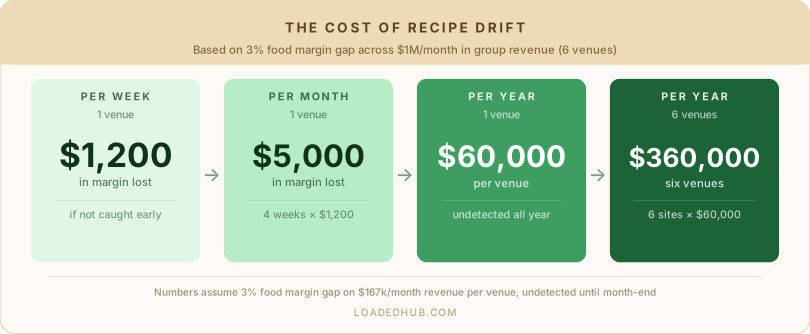
The cost shows up in four ways.
Recipe drift eats margin. When a dish costed at 28% food cost ends up running at 33% because of portion inconsistency, ingredient substitutions, or supplier price changes nobody updated for, the difference comes directly out of profit. Multiplied across a menu of 40 dishes and four venues, the total loss is significant.
Launch chaos costs management time. Releasing a new menu across multiple venues when each kitchen is working from a different version of the recipe is a co-ordination problem that takes enormous management time to execute badly. Head office is constantly chasing confirmation. Chefs are calling each other. Someone is running a dish that hasn't been approved. Someone else is still running the old version because they didn't receive the update.
Inconsistent pricing and portions confuse guests. When prices or portions vary between venues for no clear reason, it creates distrust. Regular customers notice. Group customers visiting multiple sites notice even more.
Version control is impossible without a system. When recipes live in notebooks, WhatsApp, spreadsheets or the head chef's memory, there's no way to know which version is current. When something goes wrong with a dish, you can't trace whether the problem is a recipe, a process, or a pricing decision, because no audit trail exists.
What mistakes do most multi-venue operators make with recipe and menu management?
The most common mistake is treating menu management as a once-per-cycle task rather than an ongoing deeply connected operational system. Recipes get set up at launch and then left to drift while the world around them, especially supplier pricing, changes constantly.
Recipes stay local. Each venue keeps its own copy of the recipe, usually in a folder, a spreadsheet, or a notebook in the kitchen. Head office might have a "master" version somewhere, but there's no enforced connection between the master and what's actually being used on the floor. Within months, the copies have diverged.
Ingredient prices are set at recipe creation and never updated. This is one of the most expensive habits in hospitality. A recipe might show a dish costing $6.80 in food cost, but if the key proteins have increased in price by 15% since the recipe was built, the actual food cost is closer to $7.80. The margin is being lost in plain sight, but nobody sees it because the recipe card still shows the original numbers.
Menu launches happen through email chains and PDF attachments. When a new menu is ready, it goes out as an email with a PDF attached. Some venues print it. Some don't. Some chefs make notes on it and adapt. By the time the dust settles, nobody is entirely sure what's actually being served.
The chef owns the recipe, not the business. In many hospitality groups, recipes live in the head chef's knowledge and habits rather than in a documented, version-controlled system. When the head chef moves on, a significant amount of operational knowledge walks out the door with them.
How do you manage menus consistently across multiple venues?
Well-run menu management across multiple venues works from a single centralised recipe platform, where every dish is in one place, every ingredient cost is connected to live purchasing data, and every update automatically flows to all venues at the same time.
One version of every recipe, accessible to all venues. When a recipe is updated, it's updated in one place. The change is visible to every kitchen immediately. There's no local copy to maintain, no reconciliation of different versions, and no question about which variant of a dish is current.
Recipe costs that update with supplier prices. When a key ingredient goes up in price, the recipe cost updates automatically. The food cost percentage for that dish changes in real time. Rather than discovering at month-end that a dish has been running at 38% food cost instead of 29%, each venue sees the change the moment the supplier invoice is processed and can make a pricing decision before the damage accumulates.
Menu releases that happen from one place. When a new menu is ready, it goes live across all venues simultaneously, with no email chains, no PDF attachments, and no hoping that every chef in every kitchen has read and correctly implemented the same brief. The release is a controlled process rather than a co-ordination exercise.
How does Loaded help with menu and recipe management across multiple venues?
Loaded centralises recipe and menu management so that one version of every recipe exists across all venues, ingredient costs update in real time when supplier prices change, and new menus can be released across all sites simultaneously without email chains, phone calls, or separate briefings for each kitchen.
Live recipe costing connected to actual purchasing data. When a supplier invoice is processed in Loaded, the ingredient costs in every recipe that uses that ingredient update automatically. A dish costed at 28% stays at 28% unless the world genuinely changes. When it does change, you know immediately rather than finding out at month-end.
Centralised recipe management. Recipes are stored in a single place, accessible to all venues. Head office sets the standard. Kitchens follow the same version. When a new menu is released, it's pushed to all venues at once.
Recipe profitability reporting. Beyond costing, Loaded shows which dishes are actually performing in terms of margin, so the conversation between owners and head chefs moves from "we need to fix our food costs" to "here are the five dishes driving the problem, and here's the exact ingredient change causing it." In our experience, that shift in the conversation changes everything.
Loaded also handles purchasing integration, and multi-site reporting together. When you see that food cost has moved at one venue, you can drill into exactly why, without pulling reports from three different systems and cross-referencing them manually.
For groups running on local spreadsheets and recipe notebooks, the shift to centralised management is usually most visible in the first menu cycle after setup: one version, one release, one cost calculation, consistent across every venue. The management time saved on co-ordination alone is meaningful. The margin improvement that comes from recipes that stay costed correctly tends to give a 10x ROI.
If you'd like to see how this works across your venues, we run a free 30-minute session with operators to walk through centralised recipe management with your actual menu and your actual supplier data.
Frequently asked questions
How do I release a new menu across multiple venues at the same time?
The most reliable way to release a new menu across multiple venues simultaneously is to manage all recipes from a centralised system rather than distributing copies to each kitchen. With centralised management, a menu release happens in one place and takes effect at every venue at the same time. Without it, you're relying on email chains, PDF attachments, and the assumption that every chef in every kitchen has correctly implemented the same brief.
How do I keep recipe costs accurate when supplier prices change?
Recipe costs stay current when your recipe management system is connected to your actual purchasing and invoicing data. When a supplier invoice is processed, ingredient costs update automatically across every recipe that uses that ingredient. The alternative — manually updating recipe cards each time a price changes — is too slow and too unreliable to work at scale across multiple venues.
What is centralised recipe management for restaurants?
Centralised recipe management means every recipe in the business lives in a single shared system, rather than in separate spreadsheets, notebooks, or the head chef's memory at each venue. One version of each recipe is visible to all kitchens. Costs update in real time. Changes are version-tracked. When something in a recipe changes, every venue sees the same updated version immediately.
How do I stop different chefs from using different versions of the same recipe?
The only reliable way to prevent recipe version drift across venues is to remove local copies. When each kitchen maintains its own recipe records, divergence is inevitable because each chef will make small adjustments that seem reasonable in the moment. When every kitchen accesses recipes from a single central system, there is only one version to follow. This requires technology that supports centralised recipe storage, not just a shared folder of documents that are easy to copy and modify locally.
How do I know which menu items have the best margin across my venues?
Menu margin performance across multiple venues requires a recipe management system that connects dish-level food cost data to actual sales data from your POS. When both are integrated, you can see not just which dishes have the best theoretical margin, but which dishes are actually contributing the most to profitability in practice — accounting for actual ingredient costs and actual sales volumes at each site.
How much does recipe increases cost a restaurant group?
Recipe increases typically costs 2 to 6 percentage points of food gross margin across affected dishes. On a group doing $1 million per month in food revenue, a 3% margin gap from stale recipe costs and portion inconsistency represents approximately $30,000 per month in lost profit. The cost is almost never visible as a single line item — it accumulates slowly across dozens of dishes over months, which is exactly why it persists for so long without being addressed.
What else should you read about managing multiple hospitality venues?
Menu consistency is one piece of the multi-venue puzzle. These guides cover the full picture — from operations and stock control to labour and performance reporting.
- How to Manage Multiple Hospitality Venues: The Complete Operator's Guide — the full framework for running a multi-venue group across every function.
- Multiple Venues, One Standard: How the Best Hospitality Groups Stay Consistent — the operational disciplines that keep standards from slipping as you scale.
- Multi-Venue Stock Control: How to Manage Inventory Across Multiple Hospitality Sites — recipe costs and stock control are inseparable; this is the stock side of that equation.
- How to Control Labour Costs Across Multiple Venues — menu complexity directly affects prep time and labour cost at every site.
- How to Compare Restaurant Performance Across Multiple Venues — menu performance is a key input to any meaningful like-for-like review.
- When to Open Your Second (or Third or Fourth) Hospitality Venue — menu readiness is one of the signals that you're operationally ready to expand.
- Republic Group: keeping a finger on their multi-venue pulse — how a leading Australian multi-venue group uses Loaded to stay in control.
- Restaurant Stock Control and Food Cost Management: The Complete Guide — the full framework for managing food and beverage cost across your group.
- How to Reduce Labour Costs in a Restaurant or Bar — benchmarks, weekly budgeting, and the daily habits that move the labour cost number.
See how Loaded can work for your business
If you’ve never seen Loaded in action, jump over and book a demo with us. 30 minutes is all we’ll need to show you the magic!


More Profit
Making money doesn’t happen by accident! Learn how to tune your business and improve your bottom-line.



More Success Stories
Get inspired by stories from real Loaded customers who run thriving hospitality businesses.



More Labour
Get tips for optimising your staff’s time, and for managing your team effectively.


.jpg)
More Culture
Making money doesn’t happen by accident! Learn how to tune your business and improve your bottom-line.



More Design
Making money doesn’t happen by accident! Learn how to tune your business and improve your bottom-line.

More Design
Making money doesn’t happen by accident! Learn how to tune your business and improve your bottom-line.

More Design
Making money doesn’t happen by accident! Learn how to tune your business and improve your bottom-line.



Season 2: Spring Bootcamp for a Money-Making Summer
We've poured our 100+ combined years of hospitality experience into a series of live and recorded webinars that will be your bootcamp for a money-making summer.