
Reprice your menu at least once a quarter, and review whenever a high-volume item's ingredient cost moves enough to erode its margin — not just once every six months or once a year at a full menu redesign. The clearest signs it's time to act: your food cost percentage has sat above target for more than one reporting period, a top-five item's key ingredient has gone up since you last set its price, or the menu simply hasn't changed in 12 months while your supplier invoices and pricing clearly have. Waiting for a full menu overhaul to fix pricing means giving away margin every week in between.
I sat down with an operator a few weeks back who was proud of the fact he hadn't touched his menu prices in almost a year. "Our regulars know exactly what things cost here," he told me. "We don't want to be the venue that's always going up."
It's a fair instinct, and I understand exactly where it comes from. Nobody wants to be the place people grumble about the price on the way out the door. But when we sat his current food cost percentage next to his supplier pricing from two years earlier, the story wasn't a booming business built on repeat customers. It was margin, leaking out of the business a few cents at a time, on almost every dish on the menu.
He hadn't done anything wrong. He'd just done what most operators do: treated pricing as a once-a-year decision, tied to a menu redesign, rather than an ongoing part of running the numbers. In the meantime, his suppliers had moved prices four or five times.
This guide covers exactly when to update your menu prices, the specific signs to watch for, how often it should actually happen, and how to do it without giving your regulars a reason to complain.
Why does a stale menu price cost you money?
A menu price that doesn't move while your ingredient costs do isn't neutral, it's a margin decision, made by default rather than on purpose. Every week the gap between your cost price and your sell price gets narrower, and none of it shows up as a single moment you'd notice.
Food costs in Australia haven't been sitting still. Wholesale food prices have moved up meaningfully over the past couple of years, and from July 2026 award wage rates stepped up again on top of the increases in each of the two years before it. None of this arrives as one dramatic hit. It's a few cents on a carton of eggs, a supplier surcharge on delivery, a different price on fish depending on availability. Individually, not one of those changes feels worth revisiting the menu pricing for. Together, they're the difference between the margin you built your menu around and the margin you're actually running today.
Here's what that gap looks like at scale. Take a venue doing $20,000 a week in food sales, running to a 30% food cost target. If ingredient costs drift 5% higher across the menu while prices stay exactly where they are, that's roughly $300 a week quietly moving from your gross profit to your supplier's bank account — you're still making the same food, serving the same covers, and not seeing the money.
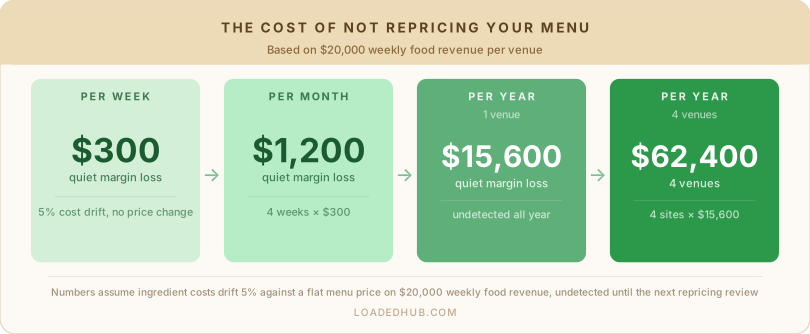
$300 a week doesn't feel like a number worth a conversation. $15,600 a year, at one venue, does. Run that same increase across four venues and you're looking at $62,400 a year — leaving the business not because anything went wrong, but because nobody looked.
I was constantly nervous about price increases myself, and I put them off far longer than our competitors did. When I finally did reprice, I wouldn't look across the whole menu — I'd just check our most popular sellers, or the items that were easiest to compare against competitors. That was a mistake. It left a number of our lower sellers, which combined were still a significant portion of our business, running well below what customers were actually happy to pay. We were leaving a lot of money on the table without realising it.
What are the signs it's time to reprice your menu?
The clearest sign it's time to reprice is a food cost percentage that's above your target for more than one month — but there are several other triggers worth watching for before it gets there, because by the time the overall number moves, the damage has usually been building for a while at your menu level.
Watch for these specifically:
- A key ingredient on a high-volume item has gone up since you last priced it. If your fish and chips accounts for 15% of covers and your fish supplier has put prices up twice since you set the current price, that dish is quietly eroding no matter how well it's selling.
- Your food cost percentage has been above target for two or more reporting periods in a row. One bad month can be seasonal noise. Two or three in a row is a pricing problem, not a blip.
- The menu hasn't changed in 12 months. Even without a single supplier price increase, wage costs, rent, insurance and utilities have almost certainly moved in that time. A menu that's stood still for a year is a menu that's been quietly absorbing every other cost increase in the business.
- A menu engineering review has flagged Plowhorse style items. If you've run your menu matrix and found high-selling items with below-average margin, that's a direct signal — not a maybe. (If you haven't run this analysis yet, our menu engineering matrix guide walks through exactly how.)
- A competitor has moved their prices up without losing visible volume. This doesn't mean copy their pricing just for the sake of it, but it's a useful signal that the market is more willing to absorb an increase than operators often assume.
- You've absorbed more than one significant cost increase (more than 5% on a high volume item) "for now." If you've said "we'll fix that at the next menu change" more than once about the same rising cost, that's usually a sign the next menu change is overdue.
TriggerWhat's happeningRecommended actionKey ingredient cost up on a top-5 itemMargin on a high-volume dish is compressing in real timeReprice or adjust that item now — don't wait for the next full reviewFood cost % above target 2+ monthsA pricing problem, not a one-off blipRun a menu-wide review, starting with your highest-volume itemsMenu unchanged for 12+ monthsEvery other cost has moved even if the menu hasn'tSchedule a full repricing review at the next seasonal menu changeMenu engineering flags PlowhorsesHigh-selling items are confirmed to be under-marginedReprice or reduce cost on the flagged items firstWage or overhead step-change (e.g. award increase)Labour cost has risen independent of food costReassess menu pricing alongside labour, not in isolationCompetitor raises prices without losing volumeMarket may be more price-tolerant than assumedTest a modest increase on 1–2 comparable items
How often should restaurants update their menu prices?
At minimum, review menu pricing twice a year, but in the current cost environment, a full quarterly review of your top-selling items is closer to what's actually needed to stay ahead of it. The right cadence depends on which layer of pricing you're talking about.
Full menu review: at least twice a year, ideally aligned with a seasonal menu change so the pricing conversation happens naturally rather than as a standalone announcement to customers.
Top-seller check: weekly. Your top 10–15 items by volume are where a cost shift does the most damage the fastest, so they deserve a closer, more frequent look than the rest of the menu. This should be simple to review — if it isn't, that's a sign to look at how you're tracking costs.
Trigger-based repricing: immediately, whenever a key ingredient on a high-volume item moves meaningfully. Don't wait for the next scheduled review if a single supplier increase has already erased the margin on one of your busiest dishes.
The mistake most operators make isn't picking the wrong cadence — it's not picking one at all, and letting pricing default to "whenever we fully redo the menu," which in practice often means once every year or two. By then, the gap between cost and price has usually compounded well past the point where a single conversation with the kitchen would have fixed it early.
What mistakes do most operators make when they raise menu prices?
The most common mistake is raising every price at once, in a single visible jump, which is exactly the moment customers notice and remember. A more effective approach spreads the increase across a smaller set of items and across time.
A few other patterns show up again and again:
- Waiting for a full menu redesign to fix pricing. A redesign is a good moment to reprice, but it shouldn't be the only moment. Treating it that way means margin erosion runs unchecked for months in between.
- Repricing without checking the recipe. A price increase on its own recovers some margin. A price increase paired with a portion or recipe check — because portions have quietly grown over time, or a supplier substitution changed the cost — recovers considerably more.
- Raising prices evenly across the whole menu instead of targeting the items that need it. A flat 5% increase on everything is blunt. It raises prices on items that don't need it and under-corrects on the ones that do.
- Absorbing cost increases indefinitely out of fear of customer reaction, then needing a much larger, much more visible increase later to catch up. Small, regular adjustments have far less negative effect than one large correction.
How do you reprice a menu without scaring off your regulars?
Reprice a small, targeted set of items rather than the whole menu at once, and pair the increase with something that makes it feel earned rather than arbitrary. Most operators overestimate how much customers notice a well-managed price change and underestimate how much they notice a badly managed one.
A practical approach that works:
- Reprice 15–25% of the menu per cycle, not the whole thing. Spreading changes across a few updates through the year means no single visit ever feels like a shock.
- Start with the items that fit the Plowhorses description in your menu matrix. These are your highest-selling, lowest-margin items — the ones where a modest increase has the biggest financial impact and the customer has already shown, through repeat ordering, that they value the dish at its current price. A $2–3 increase on a well-established favourite is usually absorbed by customers, particularly if it hasn't moved in over a year.
- Pair the increase with a small upgrade or change to the dish where you can. A slight presentation change, a new jus, or an upgraded garnish gives customers a reason the price moved, rather than a price that just moved.
- Use your seasonal menu changes as the natural moment. Repricing alongside new dishes or seasonal items means the conversation is about what's new, not just what costs more.
- Brief your floor team before the change goes live. If someone asks why a price moved, "we've held that price for over a year and unfortunately our supplier costs have gone up a couple of times since then" is a simple, honest answer that almost always lands fine. An unprepared team fumbling the question is what actually damages trust, not the price change itself.
How does live recipe costing tell you when it's time to reprice?
Live recipe costing tells you it's time to reprice the moment a dish's actual food cost moves against its menu price, not months later, when you finally sit down to check. That's the difference between reacting to a margin problem and catching it before it compounds.
The manual version of this — checking recipe costs against every invoice, line by line — is exactly the kind of task that gets pushed down the list every time the kitchen gets busy. Which is basically always. So the check doesn't happen monthly. It happens whenever there's time, which in practice can mean once or twice a year, if that.
When your recipe costs update automatically as new supplier invoices come in, you don't need to go looking for a repricing trigger — it shows up as soon as a dish's margin drifts below where it should be. You can see it on your top sellers specifically, which is exactly where the earlier sections of this guide point you to look first.
For multi-venue operators, this matters even more. Different venues can be paying different prices for the same ingredient, which means a repricing decision that's right for one site can be wrong for another. A centralised view of recipe costs and food cost per menu item, across every venue, is what makes a group-wide pricing decision an informed one rather than a guess based on whichever site's invoices you happened to check.
To see how Loaded's recipe costing and GP reporting flag margin drift on your top sellers before it costs you a quarter's worth of margin, book a free 30-minute demo. A practical conversation about your menu and your numbers.
Frequently Asked Questions About Repricing Your Menu
How often should I update my restaurant's menu prices?
At minimum, review pricing twice a year, with a weekly check on your top 10–15 selling items and an immediate reprice whenever a key ingredient on a high-volume dish moves meaningfully. In the current cost environment, a quarterly full review is a more realistic cadence than the traditional twice-a-year minimum.
What are the signs it's time to reprice a menu item?
The main signs are: the ingredient cost on a high-volume item has increased since the price was last set, food cost percentage has sat above target for two or more periods, the menu hasn't changed in 12 months, or a menu engineering review has identified the item as a Plowhorse (high sales, low margin).
Will raising my menu prices make me lose customers?
Not if it's done in small, targeted increases rather than one large jump. Repricing 15–25% of the menu at a time, focusing on well-established high-sellers, and pairing increases with a small upgrade (bigger portion, better cut, new side) is far less noticeable to customers than absorbing costs for a year and then correcting with a larger, more visible increase.
How much should I raise my menu prices by?
There's no universal figure — it depends on the specific item's cost movement and current margin. As a practical starting point, a $2–3 increase on an established high-selling item is usually absorbed without pushback, particularly if the price hasn't moved in over 12 months. The more useful approach is to calculate the actual margin gap on each item (current food cost against current price) and reprice to close it, rather than applying a flat percentage across the board.
Should I reprice my whole menu at once or just some items?
Reprice a targeted set of items rather than the whole menu. Start with your Plowhorses — high-selling, low-margin items identified through a menu engineering review — since they carry the largest financial opportunity per price adjustment. A flat increase across every item is more noticeable to customers and less targeted at where the actual margin problem is.
What's the difference between repricing and a full menu redesign?
A menu redesign changes the dishes, layout, and presentation of the menu, and typically happens once or twice a year. Repricing is a narrower, more frequent exercise — adjusting the price of specific items in response to cost movement, independent of any broader menu change. Treating pricing as something that only happens at a redesign means margin erosion goes unaddressed for months in between.
Knowing it's time to reprice is only useful if you can see the margin gap clearly enough to act on it. If your recipe costs haven't been checked against your current supplier invoices in a while, the food cost percentage you're planning around probably isn't the one you're actually running.
Loaded's recipe costing connects your purchase prices directly to your recipes across every venue, so margin drift on your top sellers shows up as it happens — not at the next menu redesign. To see how it works in your business, book a free 30-minute demo. No scripts, no pressure — a practical conversation about your menu and your numbers.
See how Loaded can work for your business
If you’ve never seen Loaded in action, jump over and book a demo with us. 30 minutes is all we’ll need to show you the magic!


More Profit
Making money doesn’t happen by accident! Learn how to tune your business and improve your bottom-line.



More Success Stories
Get inspired by stories from real Loaded customers who run thriving hospitality businesses.



More Labour
Get tips for optimising your staff’s time, and for managing your team effectively.


.jpg)
More Culture
Making money doesn’t happen by accident! Learn how to tune your business and improve your bottom-line.



More Design
Making money doesn’t happen by accident! Learn how to tune your business and improve your bottom-line.


More Design
Making money doesn’t happen by accident! Learn how to tune your business and improve your bottom-line.

More Design
Making money doesn’t happen by accident! Learn how to tune your business and improve your bottom-line.



Season 2: Spring Bootcamp for a Money-Making Summer
We've poured our 100+ combined years of hospitality experience into a series of live and recorded webinars that will be your bootcamp for a money-making summer.