


If you're only checking labour costs when the month-end P&L arrives, you're already three to four weeks too late. A problem that could be corrected in two days is left to run for three weeks before anyone sees it. This guide covers what real-time labour visibility looks like across multiple venues, what it actually costs to wait, and how to build the weekly process that protects your margins.
A few years into running our hospitality group, we settled into a rhythm with our financials that, in hindsight, was quietly costing us a lot of money.
The month would end. The accountant would pull everything together. A week or two later, the P&L would arrive. We'd sit down, look at the numbers, feel good about the strong weeks and slightly sick about the bad ones, and then try to figure out what we might do differently.
The problem was, by the time we were looking at those numbers, we were already three or four weeks into the next month. Whatever had gone wrong in October was ancient history by the time we were trying to act on it in mid-November.
For labour costs especially, this is a brutal way to run a business. Labour is one of the two or three biggest costs in any hospitality venue. It moves around constantly. Rosters change. Staff call in sick. A quiet week can turn into a disaster because you had too many people on the floor. And if you're only finding out what actually happened at month-end, you're always fighting the last war, never the current one.
This is a guide about what to look at instead, and how to build the kind of weekly visibility that lets you actually do something about problems before they compound.
Why is real-time labour tracking better than monthly P&L reporting?
Real-time labour tracking lets you compare what you're spending on wages against what you're earning in revenue during the same week, so you can make changes while there's still time to make them. Monthly P&L reporting shows you the same information weeks after the fact, when the only thing you can do is learn from it.
The difference sounds simple, but the practical impact is significant. A venue running at 34% labour cost in a week where it should be at 28% is burning through margin every single shift. Spot that on Monday, and a manager can adjust the roster before Thursday. Spot it at month-end, and you're just explaining a bad result to yourself.
For multi-venue operators, the gap is even bigger. If you're running four, six, or ten sites, your month-end P&L gives you an average. A site running dangerously hot on labour pulls the group number up, but you often can't tell which site it is until you've dug through the site-level detail, which frequently doesn't exist in a format that makes it easy to find quickly.
The operators who consistently hold their margins are looking at labour cost percentage versus revenue every week, at every site. They're not waiting for the accountant.
What does waiting for month-end labour data actually cost a hospitality group?
Waiting until month-end to review labour costs typically costs multi-venue operators between 2 and 4 percentage points of unnecessary labour spend, because problems that could have been corrected in days are left to run for weeks before anyone sees them.
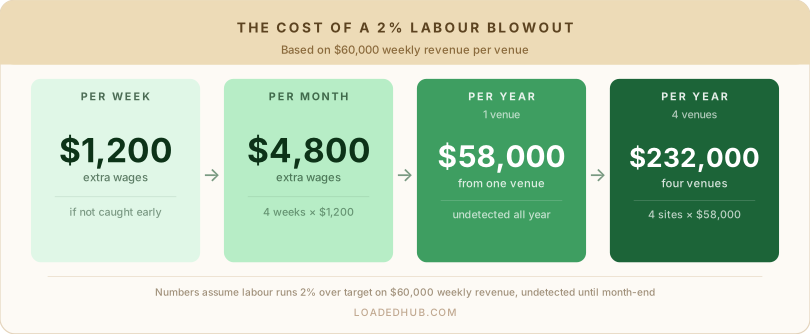
Put that in dollar terms. If a venue does $60,000 a week in revenue, a 2% labour cost blowout is $1,200 a week in extra wages. Over a month, that's around $4,800. Over a year, that's close to $58,000 from a single site. Run that across four venues and you're looking at potential leakage in the hundreds of thousands.
The problems that drive this are predictable.
Overstaffing during shoulder periods. Most multi-venue groups have at least one or two sites carrying extra people on quieter shifts. Not because anyone made a bad decision, just because the roster was built based on what happened last week rather than what's forecast for this one. You only find this at month-end if you're lucky. You find it daily if your labour is sitting next to your revenue in a live report.
Unplanned overtime. When shifts run long, the cost shows up immediately in payroll but usually doesn't reach management awareness until the monthly report. Weekly visibility catches this. Monthly visibility catches it too late.
Split-week problems. A venue might have a terrible Monday through Wednesday and a strong weekend. The weekly average can look acceptable. But by Tuesday, when you could still change the Thursday and Friday rosters, you had no signal that the week was running badly.
There's also a less obvious cost: the mental load. The operators who describe feeling like they're flying blind with labour costs almost always turn out to be reviewing monthly. Once you see the numbers weekly, it changes how the week feels to run.
What mistakes do most multi-venue operators make when tracking labour costs?
The most common mistake is using monthly average labour cost as the primary performance measure. Monthly averages feel clean and easy to report, but they hide the week-to-week variance that drives real cost outcomes.
A few patterns that come up consistently.
Tracking in dollars instead of percentages. A site that spent $50,000 on labour in a month might look similar to a site that spent $52,000. But if the first site did $160,000 in revenue and the second did $200,000, those are very different situations: 31.25% versus 26%. Tracking in dollar terms makes fair comparison across venues of different sizes almost impossible. Percentage is the number that tells you how efficiently each site is operating.
Looking at the whole month before drilling into the week. Most management teams review monthly, discuss monthly, and set targets monthly. The problem is that by the time you're reviewing May's numbers in the first week of June, the weeks where you could have intervened are long gone. The cadence needs to be weekly.
Not connecting the roster to a revenue forecast. Labour cost blowouts rarely happen because managers make outright bad decisions. They happen because rosters get built without a clear revenue forecast attached to them. If a manager builds a roster for a week they expect to do $70,000, but the week comes in at $55,000, the labour percentage will blow out regardless of how carefully they rostered. The fix is weekly budgeting before the roster is written, not a conversation about what went wrong at month-end.
Groups that report across venues in absolute dollar totals rather than site-level percentages often don't know they have a problem site until it's been running badly for two or three months. The group total can look fine while one venue bleeds. The site-by-site percentage view is what surfaces these outliers early.
How do I compare labour cost against revenue in real time across multiple venues?
The practical way to track labour cost against revenue in real time across multiple venues is to connect your rostering and payroll data to your POS revenue data, and review the resulting labour cost percentage at each site every week before the period closes.
Start with a weekly labour budget per site. Before the roster is finalised, every site manager should know: what is the revenue forecast for this week, and what is the maximum labour cost percentage that budget allows? If you're targeting 28% and forecasting $80,000 in revenue, the labour budget is $22,400. The roster gets built to that number, not to whatever you spent last week.
Then track actuals daily against the roster. A daily comparison of actual hours worked versus rostered hours, combined with actual revenue versus forecast, tells you by Tuesday whether the week is tracking to plan or heading sideways. You can adjust before the damage compounds.
Finally, review site-level percentage weekly. For a group running multiple venues, a weekly report that shows each site's labour cost as a percentage of revenue for the week just passed is the most important single document in the business. Sort it by variance from target, and it immediately tells you where to spend your management attention.
The mechanics of this depend on whether your rostering, payroll, and POS data are connected. Manual spreadsheet reconciliation can work at one or two sites but becomes unmanageable as you scale. At four-plus sites, you're generally looking at integrated software that pulls all three data sources into a single view. Otherwise the administrative cost of producing the weekly report starts to eat the time you'd spend acting on it.
What's a good weekly labour tracking process for a multi-venue hospitality group?
A simple weekly labour review process for multi-venue operators: set budgets before rosters are built, check actuals daily mid-week, review site-level percentages at the end of each week, and act on anything more than 2 percentage points above target before the next week's roster is written.
Monday: Revenue forecast and labour budget confirmed for each site. The roster is built to the budget, not to last week's pattern.
Tuesday to Thursday: Daily check on actual hours versus roster and actual revenue versus forecast. This is a five-minute task at the site level. It's what prevents a slow start to the week becoming a labour blowout by Saturday.
End of week: Site-level labour cost percentages for the week are pulled and reviewed. Any site sitting 2% or more above target gets a brief conversation: what drove it, is it a one-off, and does the roster for next week need to change?
Weekly group review: Revenue, labour cost percentage, and variance from target across all sites, side by side. This is the report that tells you where the group is tracking, which sites are performing and which need attention, and whether your overall labour position is improving or drifting.
This process doesn't require expensive software to start. A shared spreadsheet and a weekly habit will get you most of the way there. The constraint is usually time: pulling the data manually from four or five separate systems takes long enough that it's easy to let it slide, which is how groups drift back to monthly reviews.
How does Loaded help with real-time labour cost tracking for multi-venue operators?
Loaded connects your rostering, actual hours, payroll, and POS revenue data into a single real-time view, so the weekly labour versus revenue comparison is automatic rather than something your operations team has to build from scratch each week.
Live labour cost dashboard. Loaded's dashboard shows labour cost as a percentage of revenue, updated in real time from your POS, for every site in the group. The view works at site level and group level simultaneously: you can see the overall position at a glance, and drill into any venue immediately if the number looks wrong.
Weekly labour budgets tied to revenue forecasts. Before a roster is finalised in Loaded, managers can see the labour budget in dollars and percentage for the week, based on the revenue forecast. The roster gets built against a target rather than against last week's pattern. If a manager is heading toward a blowout, they can see it before publishing the roster, not after the week has run.
Loaded also handles Australian and New Zealand award rates automatically, so the labour cost figures in the dashboard reflect actual wage obligations including penalty rates, public holiday loadings, and overtime, rather than a base rate estimate that doesn't match what payroll actually costs.
For groups running on spreadsheets or disconnected systems, the shift to real-time visibility tends to produce the most noticeable impact in the first few weeks. Not because anything dramatic changes, but because problems that were previously invisible for four to six weeks become visible in two to three days. That's usually enough time to do something about them.
If you'd like to see how this works across your venues, we run a free 30-minute session with operators to show how the dashboard looks with your own data. No commitment, no sales pressure.
Frequently asked questions.
How often should I review labour costs in a multi-venue hospitality business?
Weekly at minimum, and daily for any venue that's trending above its target. Monthly reviews show you what happened; weekly reviews give you time to act. For groups running four or more venues, a weekly cross-site report sorted by variance from target is the most useful operational document in the business.
What is a good labour cost percentage for a hospitality group in Australia and New Zealand?
A well-run multi-venue group typically targets a blended average of 28-32% of revenue. By venue type: cafes and quick-service venues aim for 20-25%, full-service restaurants and bars target 25-32%, and fine dining can run 27-35%. If you're consistently above the top of your range, the most likely cause is scheduling inefficiency, and a 2-3% improvement is usually available through better rostering habits.
What is the difference between tracking labour in dollars versus percentage?
Dollar tracking tells you the size of your wage bill. Percentage tracking tells you how efficiently each venue is operating relative to its revenue. A venue that spent $50,000 on labour looks similar to one that spent $52,000, until you see that the first did $160,000 in revenue (31.25%) and the second did $200,000 (26%). Percentage is the only number that allows fair comparison across venues of different sizes.
How do I set a weekly labour budget before the roster is written?
Start with your revenue forecast for the week. Apply your target labour cost percentage to get your maximum wage budget in dollars. Forecasting $80,000 in revenue at a 28% target gives a labour budget of $22,400. Build the roster to that number, not to last week's actuals. This one change, consistently applied, prevents most of the labour cost blowouts that show up unexpectedly at month-end.
What causes labour cost blowouts in hospitality?
The most common causes are rosters built from habit rather than a revenue forecast, unplanned overtime that isn't caught until payroll runs, and split-week patterns where a slow start runs uncorrected because there's no daily visibility. None of these require a bad decision. They happen when managers don't have real-time data to act on. The fix is weekly budgeting before the roster is built, daily tracking of actuals, and a site-level percentage review at the end of each week.
How do I know if one of my venues has a labour cost problem this week?
If your rostering and POS data are connected, you'll see it in the live labour cost percentage before the week closes. If you're working manually, a daily check comparing actual hours worked versus rostered hours alongside actual revenue versus forecast will surface the problem by Tuesday or Wednesday, when there's still time to adjust the end-of-week rosters. A site running 3-4% above its target by midweek almost never recovers without intervention.
See how Loaded can work for your business
If you’ve never seen Loaded in action, jump over and book a demo with us. 30 minutes is all we’ll need to show you the magic!


More Profit
Making money doesn’t happen by accident! Learn how to tune your business and improve your bottom-line.



More Success Stories
Get inspired by stories from real Loaded customers who run thriving hospitality businesses.




More Labour
Get tips for optimising your staff’s time, and for managing your team effectively.


.jpg)
More Culture
Making money doesn’t happen by accident! Learn how to tune your business and improve your bottom-line.



More Design
Making money doesn’t happen by accident! Learn how to tune your business and improve your bottom-line.


More Design
Making money doesn’t happen by accident! Learn how to tune your business and improve your bottom-line.


More Design
Making money doesn’t happen by accident! Learn how to tune your business and improve your bottom-line.


Season 2: Spring Bootcamp for a Money-Making Summer
We've poured our 100+ combined years of hospitality experience into a series of live and recorded webinars that will be your bootcamp for a money-making summer.