


Most operators we talk to can tell you last week's sales to the dollar. Ask them what they actually spent on labour over the same week, as a percentage of those sales, and there's a pause. They'll get there eventually, usually after digging through a roster, a payroll export and a bit of mental maths. By then the week's already gone and they are still talking in approximate ranges, rather than in the cold hard facts.
If that's you, you're not doing anything wrong. Labour is genuinely one of the hardest numbers to pin down in a venue, because the pieces often live in different places and none of them talk to each other. But it's also the number that quietly decides whether a good week of trade actually turns into profit. So it's worth getting comfortable with it.
Here's the formula, what should be included, and a handful of things that trip operators up.
The formula (it's simple)
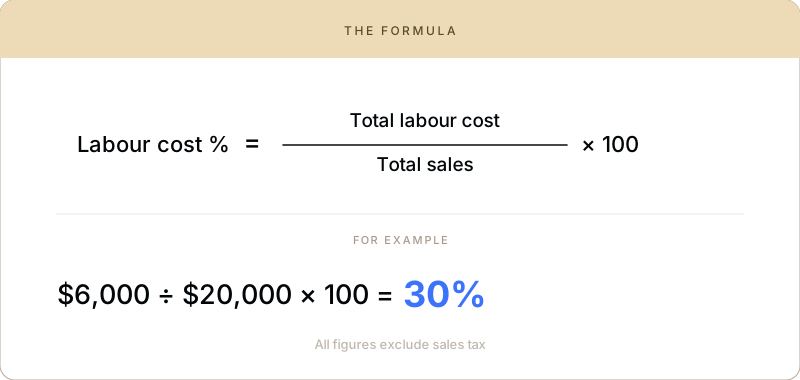
Labour cost percentage = (Total labour cost ÷ Total sales) × 100.
So if you spent $6,000 on labour in a week and did $20,000 in sales, that's 30%. That's the whole calculation. The hard part isn't the maths, it's knowing what counts as "labour cost," and getting a sales figure that lines up with the same period.
What actually goes into "total labour cost"
This is where the number most often goes wrong. Labour cost isn't just the wages on the roster.
To get a figure you can trust, include:
- Wages and salaries (front and back of house, plus salaried managers or a portion of a salaried manager if they work across multiple sites)
- Overtime and penalty/loaded rates
- Payroll tax / on-costs
- Employer superannuation (AU) or KiwiSaver (NZ)
- Holiday pay and leave accrual
- Any contractor or agency staff covering shifts
A roster total alone usually understates your real labour cost by a meaningful margin once on-costs and leave are in. If you only ever look at the roster figure, you're flattering yourself and the gap shows up later as one of those "bad surprises" in the monthly P&L.
In our own hospitality group we used to target a labour cost on site that was 3% lower than what we knew would eventually flush out in the P&L once all salary and wage on-costs were lumped in. This was OK, but we can now monitor the exact week-to-week cost in Loaded automatically with all on costs included.
What to exclude
In a multi-site group, any head office costs or operational management that isn't specifically working at the site and varies week to week, should be kept separate to the venues main labour cost. You are better off separating this in your Profit and Loss statement as well, and just having a line item for the head office charge for the time that goes into running the venue from Head office. By keeping this separate from your venue labour cost, it's easier for your Venue Manager and Head Chef to be able to track and control their labour cost and then reconcile this to the P&L at the end of the month.
Match it to the right sales figure
A percentage is only as good as the two numbers in it. Make sure your sales figure covers the exact same period as your labour figure, and ensure this is excluding GST. Mixing a net labour cost against a gross sales figure (or comparing this week's net to last month's gross) is how operators end up chasing a "labour problem" that's really just a measurement problem.
Daily, not monthly
The single biggest shift we see make a difference: stop treating labour cost as a month-end number.
By the time it lands in the monthly P&L, the labour's been paid and the shifts are long gone — there's nothing you can do about it. Labour is one of the few costs you can actually influence in real time, but only if you can see it as you roster and as your team manage a shift, not four weeks later. An operator who checks projected labour cost % while building next week's roster can move a shift, trim an over-staffed Tuesday, or pick up a gap before it costs anything. An operator who finds out at month-end can only take the pain.
We used to have end-of-month meetings with our General Manager and Head Chef at each venue, we'd be asking them questions about labour costs from rosters and shifts that happened weeks ago and unsurprisingly they couldn't remember a thing from that long ago, and we didn't end up making genuine financial improvements, we just created stress on the team without a good live system for them to actually go and solve their problems.
Where most venues go wrong
A few patterns we see again and again:
- Using the roster total as "labour cost" and ignoring on-costs and leave — understates the real wage and salary cost.
- Building each week's roster off last week's copy instead of building it against projected sales, so slow shifts get over-staffed and busy ones get under-staffed.
- Calculating it differently at each site, so the group figure can't be trusted.
- Only seeing it monthly, when it's too late to act.
- Manually pulling hours together — especially when there's been overtime or shift swaps — which eats a manager's time and still ends up wrong.
None of these are laziness. They're what happens when the roster, the POS sales data and payroll all live in separate systems and someone has to stitch them together by hand.
What good looks like
Operators who have labour under control tend to share a few habits: they include the full cost (on-costs and all), they roster against projected sales rather than habit, they use the same definition across every venue, and — crucially — they then make sure their team is managing against the roster and reporting what they actually spent for a shift vs what they were expecting to via the roster.
That last point is really an argument for having labour cost and sales sitting in the same view. When your projected wage spend updates live against forecast revenue as you build the roster, the percentage stops being a month-end autopsy and becomes something you steer with day to day.
How technology fits in
This is the friction Loaded is built to remove. Because Loaded brings POS revenue, labour, stock and the rest of your venue's performance into one connected view, you can see labour cost against actual and forecast sales as you roster — per site and across the group — instead of exporting payroll and reconciling it against sales by hand at the end of the month. No double entry, no "which version is right," no waiting for the P&L to tell you something you could've fixed two weeks ago.
It's not magic — it's just the numbers in one place, calculated the same way every time, for every venue.
Next steps
Start by calculating last week's labour cost percentage properly — full costs in, matched to the right sales figure. Then do it per venue and compare. If the numbers are hard to get to, or each site's telling you a different story, that's usually the system, not you.
Frequently asked questions.
What counts as labour cost?
More than the wages on your roster. A figure you can trust includes wages and salaries (front and back of house, plus salaried managers), overtime and penalty/loaded rates, payroll tax and on-costs, employer superannuation (AU) or KiwiSaver (NZ), holiday pay and leave accrual, and any contractor or agency staff. Leave the on-costs out and you'll understate your real labour cost by a few percentage points — which is exactly how the "bad surprises" turn up in the monthly P&L.
Should I use gross or net sales in the calculation?
Use sales excluding GST, and make sure the sales figure covers the exact same period as your labour figure. The most common mistake isn't the maths — it's comparing a net labour cost against a gross sales figure, or the last 7days numbers instead of last weeks, and then chasing a "labour problem" that's really just a measurement problem. Pick one basis and stay consistent across every venue.
Why is my roster total lower than my real labour cost?
Because the roster only shows base rostered hours. Once you add on-costs, leave accrual, overtime and any shift swaps, the real number climbs. If the roster total is the only figure you ever look at, you're flattering yourself — the gap is real and it shows up later when wages are paid.
How often should I check my labour cost percentage?
Daily and weekly per site — not monthly across the group. By month-end the labour's been paid and the shifts are long gone, so there's nothing you can do about it. Labour is one of the few costs you can actually influence in real time, but only if you can see it while you're still rostering and running shifts.
What's a good labour cost percentage to aim for?
It depends on your venue type, and the right answer is more nuanced than a single number a quick service cafe and a fine-dining room shouldn't be held to the same target. The more useful comparison is usually your own venues against each other, measured the same way. We cover the benchmarks by format in a separate guide.
See how Loaded can work for your business
If you’ve never seen Loaded in action, jump over and book a demo with us. 30 minutes is all we’ll need to show you the magic!


More Profit
Making money doesn’t happen by accident! Learn how to tune your business and improve your bottom-line.



More Success Stories
Get inspired by stories from real Loaded customers who run thriving hospitality businesses.




More Labour
Get tips for optimising your staff’s time, and for managing your team effectively.


.jpg)
More Culture
Making money doesn’t happen by accident! Learn how to tune your business and improve your bottom-line.



More Design
Making money doesn’t happen by accident! Learn how to tune your business and improve your bottom-line.


More Design
Making money doesn’t happen by accident! Learn how to tune your business and improve your bottom-line.


More Design
Making money doesn’t happen by accident! Learn how to tune your business and improve your bottom-line.


Season 2: Spring Bootcamp for a Money-Making Summer
We've poured our 100+ combined years of hospitality experience into a series of live and recorded webinars that will be your bootcamp for a money-making summer.