

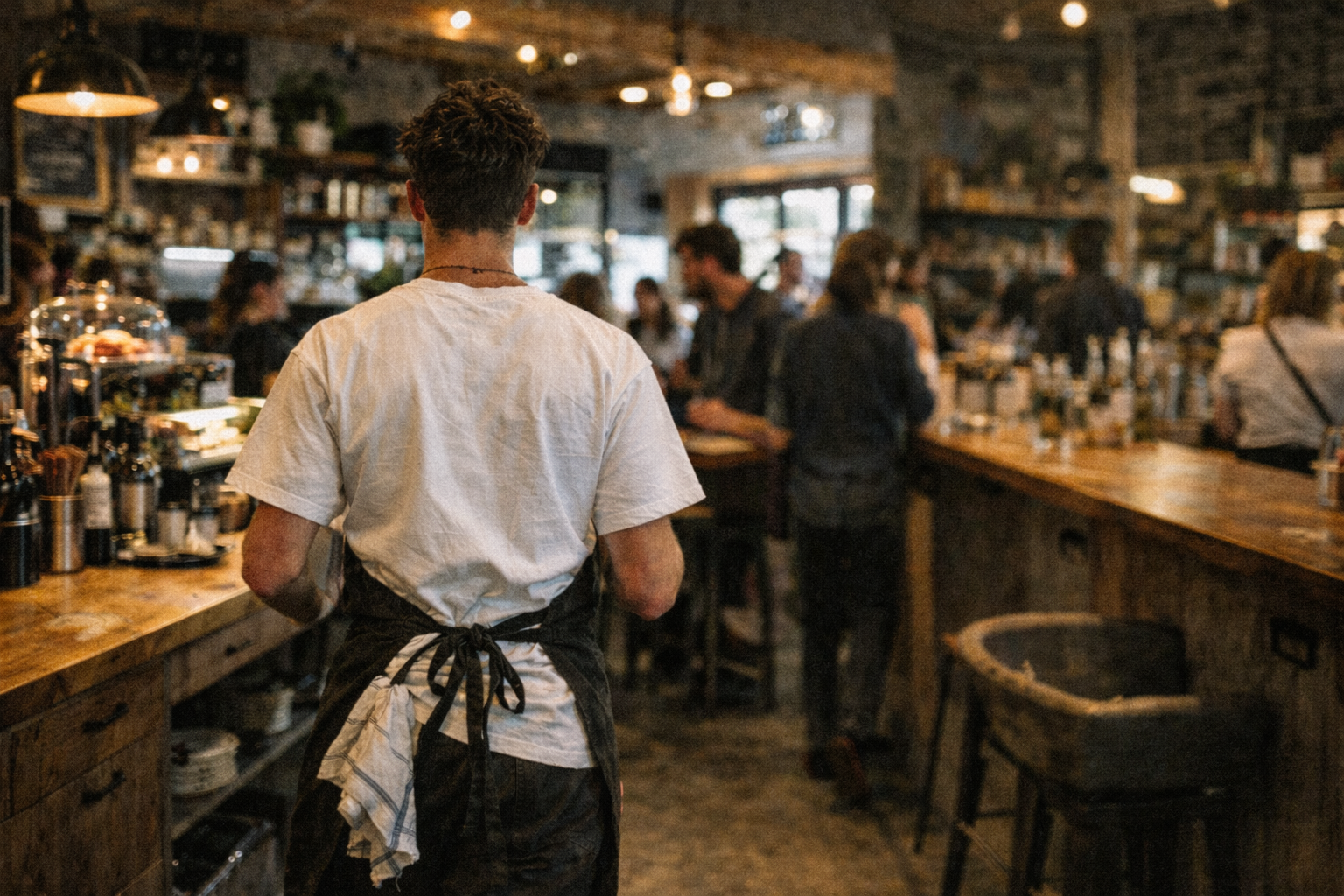
Grab your own copy of the checklist >>
When you run one venue, and you are there all the time, you can feel like you’ve got a genuine process for looking after your customers. You walk the floor, you clock the room, you can tell, without being able to explain exactly how, whether things are on-point or slightly off. You know which table is about to start feeling annoyed, and you know which waiter can turn that table around with a grin and a bit of charm (you do it yourself if you have to.)You’re present enough that the business has a pulse or a vibe you can physically feel.
I used to think that vibe meant we had our customer journey nailed.
It wasn’t. It was simply, wishful thinking.
When you open a second venue, you tell yourself a bit of a story: we’ve done this once, so we can do it again. What we’ve built will replicate. The way we greet people at the door, the way we serve drinks, the way we check dietaries, the way we land a table into starters and drinks so they relax, those things feel like “we’ve got this.” That’s the myth you want to believe because it gives you permission to scale without confronting a messy truth: most of what you think is process is actually a handful of good people making dozens of small decisions correctly, over and over, while you’re close enough to reinforce it and make change on the fly when all is not going as expected.
Then you step back. And the small decisions start to change.
Not in a dramatic way. That’s the trap. If the second venue had fallen over quickly, if the service had been obviously bad, if the reviews had been brutal, you might have fixed it straight away, because the problem would have had the decency to hit you between the eyes. Instead it arrived the way most operational problems arrive, in a form that is almost insulting in the way it sneaks up on you.
- A greeting that was fine, but not as soon as guest stepped through the door.
- A table that wasn’t offered a shared starter, so they sat there with nothing happening long enough to remember they’re hungry and get a bit impatient.
- A glass that made it all the way to empty, and then stayed empty long enough for the guest to become aware of the emptiness and get a little more impatient.
You can build an entire brand on never letting a glass get properly empty, and you can erode that trust without anyone meaning to, one empty glass at a time.
At our first restaurant, “great service” meant a reasonably specific sequence of events, even if we didn’t call it that. The maitre’d made eye contact immediately. Guests were greeted like they’d walked into someone’s home rather than someone’s business. They were walked all the way to the table. They were seated properly. The wait team was introduced by name, which sounds like a small thing until you realise the psychological effect of it: suddenly the service is happening between humans, not between “a customer” and “a staff member.”
And, crucially, the first five minutes were treated like the first five minutes of someone stepping into your own home. You either get it right or you spend the rest of the night trying to recover from a feeling the guest can’t quite put into words. Drinks were offered straight away. If the table hadn’t ordered starters, shared starters were suggested, because “nothing underway” is the enemy of great hospitality. Dietaries were asked early, not as a defensive move, but as an act of care. Water was offered and served immediately, as both a ritual and a signal that someone is paying attention and cares.
None of this was ground breaking. But it felt repeatable. Which is another way of saying it was system-like, even if it lived mostly in people’s heads.
Then we added venues, and the repeatability turned out to be b*#lls#*t.
What changed first was not effort. Everyone worked hard. That’s what made it super annoying. What changed was interpretation and standards. At venue one, a manager thought “drinks within five minutes” was a standard. At venue three, someone thought it was an aspiration, the kind of thing you say in training because it sounds good, a sentence that floats above what actually happens during a busy service.
At one site, the team would naturally suggest sides that matched mains, because they’d been trained on the menu in a way that made matching feel like hospitality. At another, the team would wait to be asked, because no one had made it clear that a side is not an extra; it’s part of the experience. At one venue, “checking in after two minutes” meant a genuine pause, eye contact, and a real look for cues that something isn’t right. At another, it became a drive-by: “Everything all good?” delivered at the speed of a person who doesn’t want to hear the answer.
The most dangerous form of inconsistency in hospitality is the kind that looks like competence. It passes the casual glance test. It might even pass the manager’s gut feel on a good night. But it doesn’t pass the customer’s subconscious scorecard, the one they carry without knowing they carry it. The customer doesn’t say, “I wasn’t offered shared starters early enough to create momentum at the table.” They say, “It was a bit average.” Or worse, they don’t say anything at all; they just don’t come back.
What happened as we grew was that we started having the same conversation, over and over, in different disguises. My business partner would say, “I don’t know what it is, but the vibe isn’t quite right.” A manager would say, “We’ve got a few staff who just don’t get it.” You can blame people forever in hospitality because the work is emotional and visible and human. It always feels like a people problem. If a guest leaves unhappy, you can point to the person who interacted with them and say, “They are the problem.”
But when we bothered to look properly, it almost never went wrong because someone was lazy or careless. It went wrong because we had never actually agreed, on paper, in a way that survived team turnover and roster changes, what “great” looked like, step by step. We were trying to replicate something we hadn’t defined. We were trying to replicate a “vibe”
Vibes in hospitality are not easy to replicate. Processes are.
So we did the thing we didn’t want to, we wrote it down. Not as a manifesto, not as a motivational poster, but as a customer journey map that treated the customer experience like a chain of logical moments, each one owned by someone. Door. Seating. First five minutes. Ordering. Service. The finish. Payment. Farewell.
We turned it into a training document, because training without a document is just a story one person tells another. Then we made a shortened poster version that lived front and center, because a training document that isn’t reinforced becomes forgotten, the kind of thing you print once and then forget about. The shortened version lived somewhere prominent, because the point wasn’t to create a policy; it was to create a shared language. When you want consistency across multiple venues, you don’t need more passion. You need alignment.
And then, because people are people and memory is unreliable and busy nights make liars of all of us, we built a secret shopper system around the same Customer Journey. The map wasn’t a nice-to-have. It was the scorecard. The shopper wasn’t asked, “Did you have a good time?” They were asked whether the welcome happened properly, whether dietaries were asked early and handled with care, whether drinks were delivered within five minutes, whether the table was guided toward shared starters if nothing had been ordered, whether anyone noticed a glass under a quarter full, whether dessert menus appeared before the bill was even in the conversation, whether the goodbye felt like warmth rather than procedure.
What this did, almost immediately, was change the internal conversations. Managers stopped managing by mood. They stopped saying, “She’s great” or “He’s hopeless,” which are the two laziest sentences in hospitality, because they feel like judgement but contain no information. Instead they could say, “We’re dropping the first five minutes standard on Friday nights,” or “We’re not introducing the wait team by name,” or “We’re missing drink attention during mains.” Those sentences are actionable. They have a fix.
And once the steps were clear, something else happened that we hadn’t fully appreciated: onboarding a new front of house team member was a lot faster. They didn’t have to absorb the culture through osmosis and guess what they should do. They had a playbook. They could get to an eight out of ten quickly not because they were brilliant, but because the system carried them through the moments that matter most. Their personality still did the work, hospitality will always be human, but it did the work inside a structure that protected the experience from inconsistency.
The real lesson in all of it, the one that only becomes obvious when you’ve tried to scale without it, is that consistency is not a trait. It’s an engineered outcome. When you have one venue, you can pretend otherwise because you are the glue. When you have multiple venues, that gets hard, really fast. The glue has to be a system, a checklist, a shared language, and a measurement system that provides accountability and good information on where it can be improved.
You don’t scale hospitality by hoping the best people keep showing up.
You scale it by designing an experience that people can deliver well, on a busy night, when the kitchen is flat stick, when the bookings are stacked, when the roster is slightly lean, when the manager is pulled in three directions, because, let’s be honest that is what hospitality is, most of the time.
And once you design it, you can actually manage it. You can find where it’s breaking rather than searching for someone to blame. You can fix the step instead of berating the person. You can turn “vibe” into process without killing the warmth that made you awesome in the first place.
That’s the paradox: the more you systemise the customer journey, the more room you create for your team to show up with genuine hospitality,consistently, across every shift and every venue.
Anyway, enough of my ranting. This is what you need in place to fix it.
- A customer journey map
Every step from arrival to farewell. Who owns it. What “great” looks like. - A proper training document
Clear standards. Clear expectations. Not “shadow Sarah for three shifts”. - A shortened version that lives somewhere prominent
The non-negotiables. Wall / iPad / pass / pre-shift briefing. If it’s not visible, it’s not real. - A secret shopper system built around the map
The journey map is the scorecard. It’s how you measure drift before it becomes reviews.
The Customer Journey Checklist
Use this checklist as the basis for your staff training, your on shift management and your secret shopper system.
While every venue is different you can tweak this concept for a cafe, a gastro pub, a fine dining restaurant and everything in between.
Door & Welcome - Maitre’d
- ☐ Eye contact + smile immediately
- ☐ Introduce yourself and Greet like a guest in your home
- ☐ Walk guests all the way to table and seat
- ☐ Introduce wait team by name
Goal is a very warm and hospitable first impression, that makes guests feel like they’ve made the exact right decision to visit us.
Seating - Floor Team
- ☐ Introduce yourself, key that everyone knows your name
- ☐ Menus down as Ask about dietaries/allergies early
- ☐ Acknowledge and reassure
- ☐ Tailor recommendations to dietaries
- ☐ Still or Sparkling water - then serve immediately
- ☐ Communicate todays' specials
Goal is a memorable first impression and a table of customers that now know you on a first name basis.
First 5 Minutes - Floor Team
- ☐ Drinks offered
- ☐ Shared starters for the table suggested
- ☐ Suggestions fit dietaries for the table
- ☐ Drinks delivered within 5 minutes of ordering
Goal is drinks and shared starters underway at the table, with everyone relaxed and enjoying themselves immediately.
Ordering - Floor Team
- ☐ When possible order in clockwise order starting at person closest to you.
- ☐ Personalise suggestions and line them up with dietaries.
- ☐ Suggest starters if none have previously been ordered for the table.
- ☐ Suggest sides that match with mains. Remember your training here.
- ☐ Ask if they would like any suggested wine/drink matches with the orders they have been made.
- ☐ Confirm course timing. Manage expectations based on how busy the kitchen is helps people relax.
Goal is people feel delighted with our knowledge of the menu and feel like we have personalised what we have suggested they ordered. We have highlighted all of the great menu and drink items we have available.
During Service - Floor Team
- ☐ Take out any specialist cutlery required based on the orders each customer has made.
- ☐ Serve meals as they are available but ensure you know where every meal is to be delivered. Take 15 seconds at the pass to review docket and remind yourself.
- ☐Offer salt and pepper
- ☐Check in after two minutes, Is there anything else I can get you or anything that you want to let me know about your meals? Pause and genuinely look for cues that people are not happy.
- ☐ Fix and meal issues fast and communicate with the Kitchen. Remember they are there to help you solve.
- ☐ Clear plates only once all guests have finished. Shared starters cleared as plates are empty.
- ☐ Eye drinks every pass of the table
- ☐ Golden Rule - Any glass under ¼ fil → offer refill
Goal is we understand any potential issues quickly. No guest reaches empty glass without being offered their next drink.
The Finish - Floor Team
- ☐ Dessert menus always placed on the table as you ask people if they want dessert.
- ☐ If people clearly don’t want desserts, then don’t push, but let them know the menu also has coffee, aperitifs and dessert wines. Make a personal suggestion of what you love.
Goal is guests have had our full experience, from starters all the way through to dessert.
Close & Farewell - Maitre’d
- ☐ Make Payment smooth and flexible based on how they want to pay.
- ☐ Ask feedback question and be genuine, If there was one thing we could have done better for you tonight what would it have been?
- ☐ Genuine thank you
- ☐ A Warm goodbye like a friend leaving our home
Goal is people feel like they’ve had an experience and a warmth from our team that makes them want to come back next week and bring friends to show them how great it is here.
See how Loaded can work for your business
If you’ve never seen Loaded in action, jump over and book a demo with us. 30 minutes is all we’ll need to show you the magic!


More Profit
Making money doesn’t happen by accident! Learn how to tune your business and improve your bottom-line.



More Success Stories
Get inspired by stories from real Loaded customers who run thriving hospitality businesses.

More Labour
Get tips for optimising your staff’s time, and for managing your team effectively.

.jpg)
More Culture
Making money doesn’t happen by accident! Learn how to tune your business and improve your bottom-line.


More Design
Making money doesn’t happen by accident! Learn how to tune your business and improve your bottom-line.

More Design
Making money doesn’t happen by accident! Learn how to tune your business and improve your bottom-line.

More Design
Making money doesn’t happen by accident! Learn how to tune your business and improve your bottom-line.


Season 2: Spring Bootcamp for a Money-Making Summer
We've poured our 100+ combined years of hospitality experience into a series of live and recorded webinars that will be your bootcamp for a money-making summer.